
New Testosterone Spray
A Modern Approach to Hormone Therapy
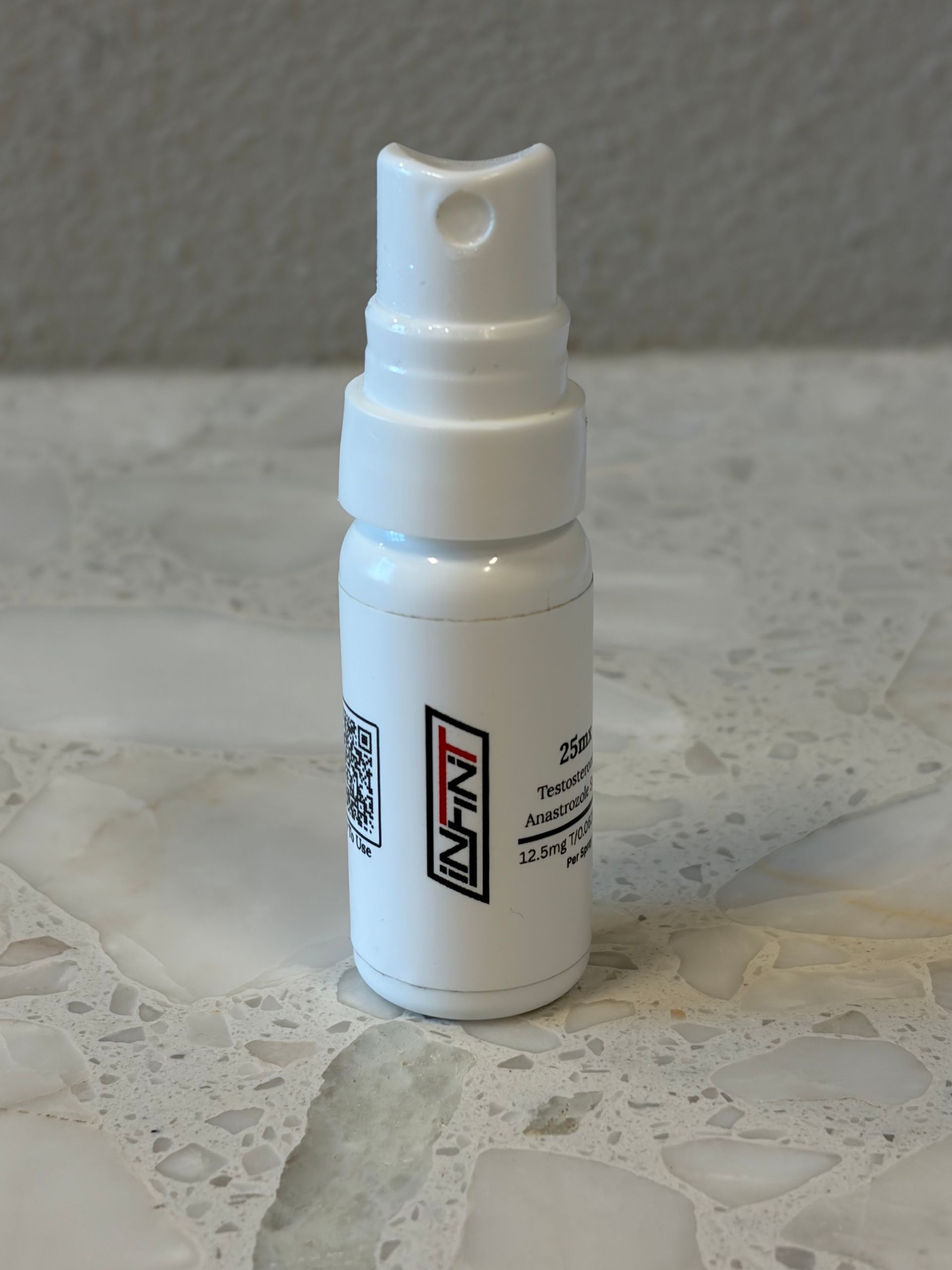
Advances in hormone therapy continue to create new options for men seeking treatment for low testosterone. The new testosterone spray offers a convenient alternative for eligible patients, providing a method designed to fit easily into a daily routine while supporting healthy testosterone levels.
At InfiniT Men's Health, we help patients explore the treatment options that best match their needs and goals. Our knowledgeable team explains how each therapy works, discusses potential benefits, and develops personalized care plans based on your health profile. Request a consultation today to find out if the testosterone spray may be right for you.
Daily Testosterone + Anastrozole Transdermal Spray
- Consistent daily dosing with the ability to make individualized dose adjustments based on laboratory results and how the patient feels.
The formulation combines
testosterone and anastrozole in a compounded transdermal spray.
Why Daily Dosing?
Hormones are naturally produced and regulated continuously by the body.
Rather than administering a relatively large amount of testosterone at one time, overloading your receptors, and then causing the negative feedback shutdown, the spray is administered once daily to allow for microdosing that does not cause the negative feedback loop or shutdown of LH and FSH (pituitary hormones that stimulate your natural testosterone and sperm production).
The goal is to provide a more consistent treatment regimen that can be adjusted to the individual patient.
Our current clinical study is evaluating whether this approach can produce stable month-to-month levels of:
- Total testosterone
- Estradiol
- Hemoglobin
- PSA
Patients are also monitored for symptoms and potential side effects.
Individualized Dosing – “Dialing In”
Every patient is unique, and not everyone needs exactly the same testosterone dose.
Treatment begins at an appropriate daily dose and can be adjusted up or down based on the patient's lab results and symptoms.
Instead of making unnecessarily large changes in testosterone dosing, the objective is to identify the dose that works for the individual patient.
We refer to this process as getting “dialed in.”
In our current research protocol, treatment stability is defined by three components:
1. Symptoms have improved.
The patient should experience meaningful improvement in the symptoms being treated.
2. Hemoglobin remains controlled.
Hemoglobin should remain below 17 g/dL for at least six consecutive months.
3. The testosterone dose is stable.
The patient's dose should remain unchanged for at least three consecutive months.
The objective isn't simply to produce a particular testosterone number.
The objective is to find a dose and testosterone level at which the patient feels better while laboratory values remain stable.
Why Does The Spray Contain Anastrozole?
Testosterone can be converted into estradiol through an enzyme called aromatase.
Estradiol is a normal and important hormone in men. The objective is therefore not to eliminate estradiol.
Anastrozole is an aromatase inhibitor. It is included in this compounded formulation as part of the treatment strategy for controlling testosterone-to-estradiol conversion.
Because individuals can respond differently, testosterone and estradiol are monitored during treatment.
Testosterone and High Hemoglobin
One of the most important laboratory changes that can occur during testosterone therapy is an increase in red-blood-cell production.
This can cause increases in:
Red blood cells → Hemoglobin → Hematocrit
When these levels become excessively elevated, the condition is often referred to as testosterone-induced erythrocytosis or secondary polycythemia.
Our previous published research investigated an approach to controlling the polycythemia effect associated with TRT.
The new daily spray study builds upon that work.
Rather than waiting for hemoglobin to become significantly elevated and only treating the laboratory value afterward, the treatment strategy is designed around avoiding the issue with regular monitoring and individualized adjustment of testosterone therapy.
What Makes This Approach Different?
DAILY ADMINISTRATION
Designed to provide a consistent daily treatment regimen rather than larger, less frequent doses.
SMALLER, INDIVIDUALIZED DOSE ADJUSTMENTS
The goal is to identify the amount of testosterone appropriate for each individual rather than using the same dose for everyone.
TESTOSTERONE + ANASTROZOLE
The compounded spray contains testosterone together with anastrozole to manage testosterone-to-estradiol conversion as part of the treatment strategy.
LABS + SYMPTOMS
Treatment decisions aren't based solely on a testosterone number. Laboratory results are evaluated together with how the patient is actually responding.
MONTHLY MONITORING DURING THE STUDY
Study participants undergo monthly laboratory testing and symptom assessments so treatment response and safety can be followed over time.
What Are We Currently Studying?
InfiniT Men's Health Clinic is conducting an IRB-reviewed clinical study evaluating this daily testosterone/anastrozole transdermal spray.
The study is designed to evaluate:
- Stability of testosterone levels
- Estradiol levels
- Hemoglobin levels
- PSA levels
- Changes in symptoms
- Average daily dose required for stable treatment
- Range of doses required among different patients
- Potential changes in A1c and TSH
Approximately 100 participants are enrolled, with participants followed monthly for approximately 6–12 months.
Important Safety Information
The testosterone/anastrozole combination spray being studied is an investigational compounded formulation and has not been approved by the FDA as a combination product.
Potential risks associated with testosterone therapy include elevated hemoglobin/hematocrit, acne, fluid retention, mood changes, infertility, changes in PSA and other potential adverse effects.
Anastrozole can also cause adverse effects, including excessively low estradiol, joint discomfort, fatigue, dry skin, constipation and mood changes.
Regular laboratory testing and clinical monitoring are therefore an important part of treatment.
The Goal
The goal isn't to give every man the same dose of testosterone.
The goal is to identify an individualized dose that provides symptom improvement while maintaining appropriate hormone levels and minimizing adverse effects.
Testosterone replacement should be individualized.
InfiniT Men's Health Clinic
Research Study: “Dialing in Testosterone Spray Dosing”
Principal Investigator: Shane Kelleher, PA-C